
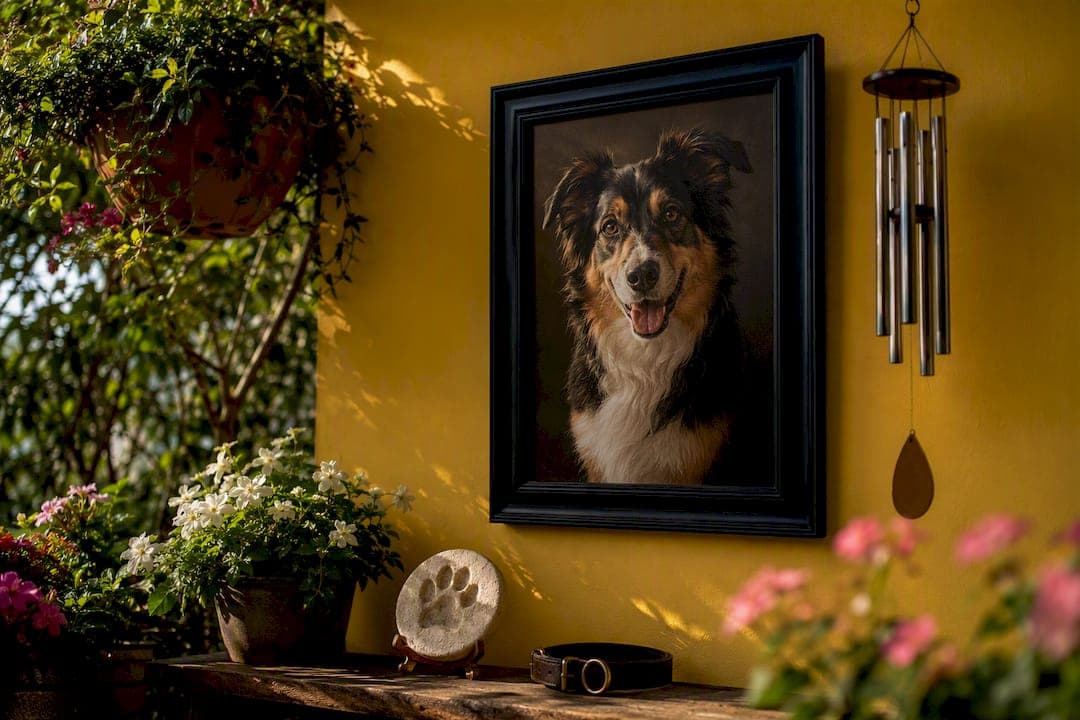
The most lasting way to remember a pet is a bespoke memorial portrait, and the easiest place to start is Motley Studio, which builds custom artwork from your own photos. Below, you'll find exactly how the commissioning process works, what photos and details to send, realistic timelines, and how to write the words that go alongside the image.
TL;DR:
- Sending clear, focused photos with natural light and multiple angles reduces revision rounds and ensures a more accurate likeness.
- Choosing a realistic style in oil or acrylic on canvas is best for an exact, lasting memorial, especially for high-contrast markings.
- Clarifying the portrait's purpose, size, and deadline upfront helps manage costs and enables timely delivery, especially for special occasions.
- Including specific anecdotes and details in the brief creates a more heartfelt and authentic tribute that resonates with viewers.
- Displaying the portrait alongside keepsakes in a layered memorial space enhances its emotional impact and aids remembrance.
Table of Contents
- Pet obituary examples and portrait tributes: how commissioning works step by step
- Choosing style, medium and size for a memorial portrait
- What photos and briefing notes actually help the artist
- Timeline, pricing shape and how revisions actually work
- Displaying, gifting and pairing the portrait with keepsakes
- Pet obituary text examples and phrasing that feels genuine
- Tips for writing an obituary that feels heartfelt, not hollow
- The structure most pet obituaries follow
- Weaving in the memories that actually matter
- Where to share the obituary once it's written
- Why we think every pet deserves more than a photo on a phone
- Start your commission with Motley Studio
- Sources
Pet obituary examples and portrait tributes: how commissioning works step by step
Ordering a memorial portrait isn't a single transaction. It's a short collaboration between you and an artist, usually five stages long, and knowing them in advance means fewer surprises and a better likeness.
The typical workflow runs from inquiry through to delivery, and most studios (Motley Studio included) structure the process this way:
- Inquiry and format decisions. You choose the style (realism, watercolour, digital), size, and whether it's printed on canvas or paper.
- Photo and brief submission. You send reference images plus a short note on the pet's personality, markings, and what you want the piece to capture.
- Sketch or draft approval. The artist produces an initial version, often a rough sketch or digital proof, before committing to final work.
- Revision rounds. You flag anything that doesn't feel right, whether it's the angle of an ear or the colour of the eyes, and the artist adjusts.
- Final production and delivery. The approved version gets printed, framed if needed, and shipped or arranged for collection.
Most of the emotional weight in this process sits in step two. A rushed or thin brief tends to produce a technically fine portrait that still doesn't feel like your pet. Slow down there and everything downstream gets easier.
Choosing style, medium and size for a memorial portrait
Realism captures your pet exactly as the camera saw them, down to the fleck in an eye or a scar from an old scrape. Painterly or stylised treatments do something different: they soften the image into more of a memory than a photograph. Owners choosing memorial work often pick realism when they want an exact likeness, and softer styles when they want something gentler to look at every day.
Medium changes the mood as much as the technique:
- Oils or acrylics give depth and a traditional, gallery-quality finish.
- Watercolour feels lighter and more delicate, often suited to smaller or gentler animals.
- Charcoal works well for dramatic contrast, particularly on dogs with strong facial markings.
- Digital illustration offers the most flexibility for colour, background, and stylisation.
On printing, canvas tends to be recommended for memorial pieces because it ages well and reads as art rather than a photograph, while metal prints suit animals with strong, high-contrast markings that benefit from a sharper, glossier finish.
Size depends on where the piece will live. A5 to A4 suits a desk or bedside table. Anything from 40x50cm upward works for a mantelpiece or hallway, where the portrait becomes something guests notice too.
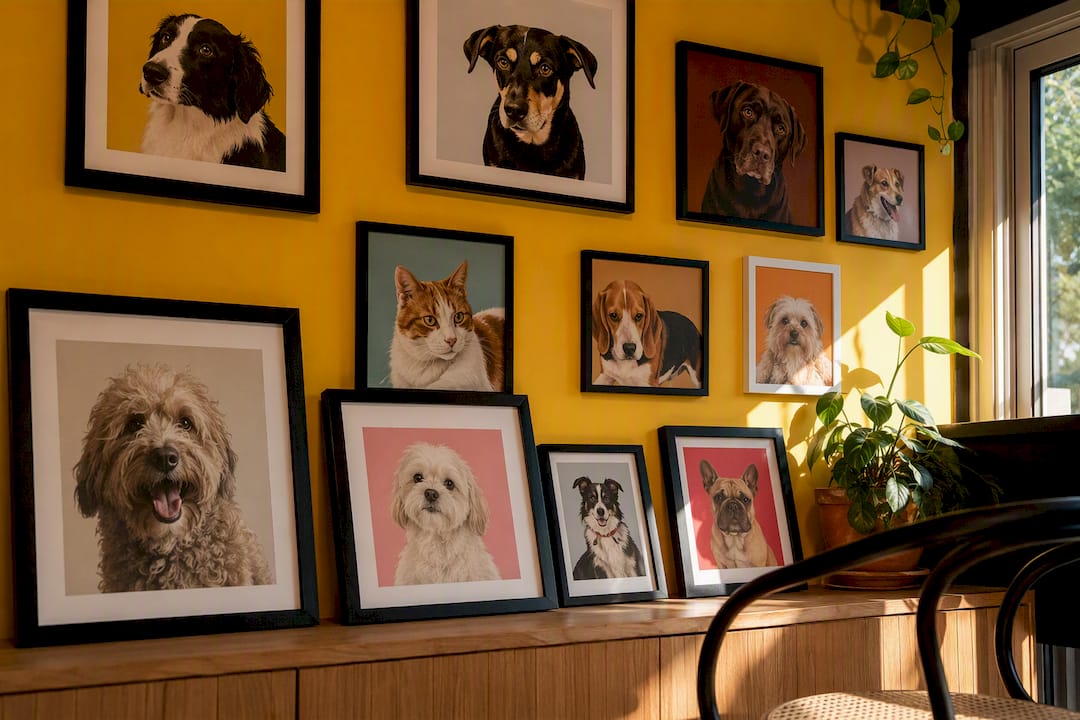
Pro Tip: If you're torn between two styles, ask the artist for a small digital proof in each before committing to the full-size piece. It costs little and saves you from regretting the choice on something permanent.
What photos and briefing notes actually help the artist
The photos you love most on your phone aren't always the ones that make the best portrait. A blurry, backlit shot from a birthday party might be precious to you, but it gives an artist almost nothing to work from.
Good reference photos share a few traits: sharp focus on the eyes, natural daylight rather than flash, and at least one straight-on or three-quarter angle so the artist can judge proportions properly. Sending several images from different angles cuts down on revision rounds later.
Beyond photos, a short written brief makes a real difference:
- State what role the portrait will play (a living-room centrepiece, a quiet desk tribute, a gift for a grieving family member).
- Describe the expression you want, alert, sleepy, mid-play, rather than leaving it to guesswork.
- List any details that must be exact: "please keep the white patch above his nose," or "her left ear always flopped slightly, that's important to us."
- Mention markings that are easy to miss in a single photo but obvious to anyone who knew the pet.
Artists working on memorial commissions often suggest depicting the pet at a healthier stage of life if the most recent photos were taken during illness. There's no rule that the reference image has to be the last one ever taken.
Timeline, pricing shape and how revisions actually work
Cost on a custom pet portrait is driven by four things: size, medium, complexity (multiple pets, detailed backgrounds, intricate markings), and whether you need framing or a rush turnaround.
Delivery timelines vary by studio and workload, but a few questions are worth asking before you commit:
- How many revision rounds are included in the price, and what happens if you need more?
- Is there a rush option, and does it carry an additional fee?
- Will you see a sketch or digital proof before the final piece is produced?
- What's the total time from approved brief to delivery at your door?
If the portrait needs to be ready for a specific date, a memorial gathering or an anniversary, telling the artist that date upfront matters. Many studios can accommodate a rush job for a fee, but only if they know early enough to plan around it.
Setting milestones early saves grief later. Agree on the number of revision rounds, the delivery date, and what happens if you're still not happy after the final round, before any payment changes hands. A studio that puts this in writing at the inquiry stage is one that takes the commission seriously.
Displaying, gifting and pairing the portrait with keepsakes
A portrait rarely stands alone in a home. Most owners build a small, layered memorial space around it: the artwork itself, alongside a keepsake or urn, plus one small personal object, a collar, a favourite toy, a paw print cast.
Families often combine a portrait with a small keepsake or urn to create that layered memorial space, rather than treating the portrait as a stand-alone piece.
A few practical notes on gifting and sharing:
- If you're commissioning a portrait as a gift for someone still grieving, send the portrait itself before raising the subject of ashes or urns. Grief timing matters more than convenience.
- Smaller formats, postcard prints or pocket-sized copies, work well for sharing with relatives who want something personal without a large piece of art to display.
- Consider a second, smaller print for a car, wallet, or desk at work, somewhere the pet's memory travels with you day to day.
Pet obituary text examples and phrasing that feels genuine
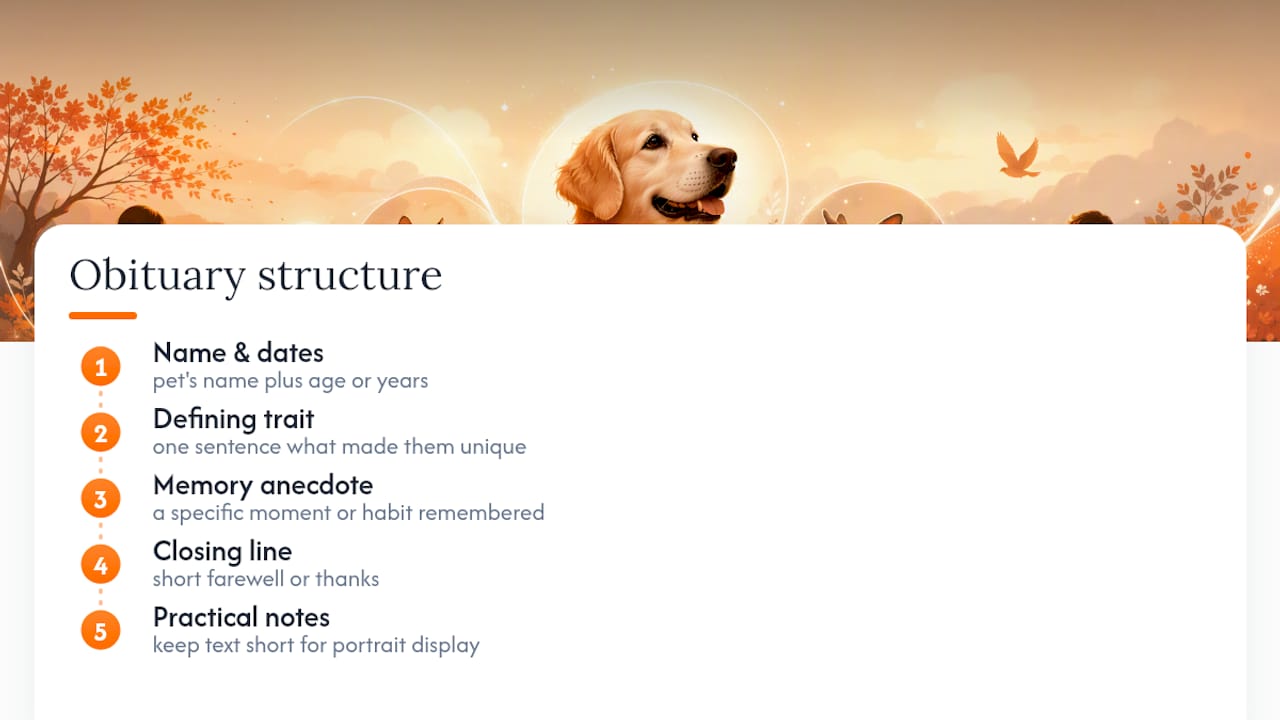
Whether the words sit beside the portrait, go into a card, or get shared online, the strongest pet obituaries follow a simple shape: name, dates or approximate age, one defining trait, one memory, and a closing line.
A short, warm example: "Biscuit, our golden retriever and self-appointed greeter of every visitor, left us peacefully at home aged 13. She never met a stranger, only a future friend. She'll be missed at the door, on the sofa, and underfoot in the kitchen every single evening."
A quieter, more reflective version: "Whiskers arrived as a rescue kitten who trusted no one, and left as the cat who slept on every family member's bed in turn. Fifteen years of quiet company. Thank you for choosing us."
For a working or farm animal: "Duke served as our sheepdog for nine years without a single lazy day. He is remembered for his patience with the lambs and his complete disregard for bad weather."
None of these need to be long. A sentence naming what made the pet distinctly themselves, followed by a specific memory rather than a generic sentiment, does more work than three paragraphs of general praise. If the obituary accompanies a portrait, keep the text short enough to read in the time it takes to look at the artwork itself.
Tips for writing an obituary that feels heartfelt, not hollow
Generic phrases like "beloved companion" or "will be dearly missed" aren't wrong, but they say nothing that distinguishes this pet from any other. The obituaries that actually move people are specific.
Write in the pet's voice occasionally if that feels natural to your family. Some of the most memorable pet obituaries are written in first person, from the animal's perspective, which naturally forces specificity because you have to imagine what they'd actually say.
Avoid over-explaining the cause of death unless it matters to the tribute. A line acknowledging illness or old age is enough; the obituary is a celebration of a life, not a medical record.
Keep sentences short. Grief writing tends to ramble when it's trying to capture everything at once. Pick two or three moments that mattered and let them stand for the whole relationship rather than attempting a complete biography.
Read it aloud before sharing it. If a line sounds stiff or borrowed from a template, rewrite it in the words you'd actually use talking to a friend about your pet. That's usually the version that lands.
The structure most pet obituaries follow
Most well-written pet obituaries share a loose but recognisable structure, even when the tone varies wildly between families.
They open with the name and basic facts: species, breed if relevant, and either an exact age or an approximate span of years together. This grounds the reader before the emotional content begins.
The middle section carries the personality and the anecdotes, usually one or two specific stories rather than a list of traits. This is where "loyal" and "playful" get replaced with an actual scene: the time the dog stole a sandwich off the counter, the cat who only slept on clean laundry.
A closing line usually addresses gratitude, either to the pet directly or to those who supported the family through the loss, veterinary staff, friends, or family members who helped during the final days.
Some obituaries add a practical note at the end, mentioning a memorial fund, an animal charity donation in lieu of flowers, or simply an invitation for others to share their own memories.
Weaving in the memories that actually matter
The anecdotes that work best are small, sensory, and specific. Not "he was a good dog," but the exact thing he did that no other dog would have done.
Think about the moments that come up naturally when you talk about the pet with someone who knew them: the noise they made when the treat bag opened, the spot they always claimed on the sofa, the walk route they refused to deviate from no matter the weather.
One well-chosen anecdote outperforms a paragraph of adjectives every time. If you're struggling to choose, ask other family members what they remember most, you'll often find the same one or two stories come up independently, which tells you they're the ones worth including.
Where to share the obituary once it's written
Pet obituaries now live in more places than a printed newspaper column ever did, and where you share it depends on who you want to reach.
Social media remains the most common route, a dedicated post lets friends and family respond with their own memories, which can be genuinely comforting in the days after a loss. Pet loss forums and breed-specific communities offer a more focused audience who understand the particular bond with that type of animal.
Some families choose a printed card sent to close friends and relatives, paired with a small photo. Others use dedicated pet memorial websites that host the text alongside photos permanently, functioning as a lasting digital record. Whatever platform you choose, pairing the written tribute with the physical portrait, displayed at a memorial gathering or simply at home, gives the words somewhere tangible to live alongside the image.
Why we think every pet deserves more than a photo on a phone
At Motley Studio, we've built our entire process around one idea: a photo on a phone gets buried under a thousand others within a week. A portrait on a wall doesn't. That's the gap we exist to close, turning the reference photos and memories you already have into something that stays visible.
Our gallery shows the range this can take, from bold, vivid stylised pieces to quieter, more realistic work. Before you contact us, gather your best reference photos, a few lines on personality and markings, and a rough idea of size and placement. That preparation alone shortens the whole process.
— Motley
Start your commission with Motley Studio
Motley Studio is built specifically for pet owners who want a genuine likeness, not a generic template stretched to fit any animal. Every piece starts from your own photos and your own words about what made that pet distinctly them, worked through a process with proper revision rounds rather than a single take-it-or-leave-it draft.
Ordering starts on the custom portraits page, where you pick your size, medium, and framing before uploading reference photos and a short brief. From there, you'll see a sketch or digital proof before any final production begins, so nothing goes to print until you've confirmed it captures your pet properly. Rush options are available if you're working toward a specific date, such as a memorial gathering or anniversary, so mention that early in your inquiry. If you want to see the range of styles first, browse the full gallery, then head to the ordering page when you're ready to begin.
Sources
The commissioning advice in this piece draws on published guidance for choosing a portrait artist and preparing reference photos, alongside Motley Studio's own product pages for readers ready to order.